What the Highveld sun actually does to a house in this suburb — elevation by elevation, season by season — and what we would fit on each opening, including where each option is the wrong answer. Read it, use it, take it to whoever you like.
sun pathelevation by elevationwhat we would fit, and whythe trade-offsscheme ruleswhat only a site visit answerssun pathelevation by elevationwhat we would fit, and whythe trade-offsscheme ruleswhat only a site visit answers
01 — Why this suburb gets its own guide
Half of Rivonia is governed by a drawing.
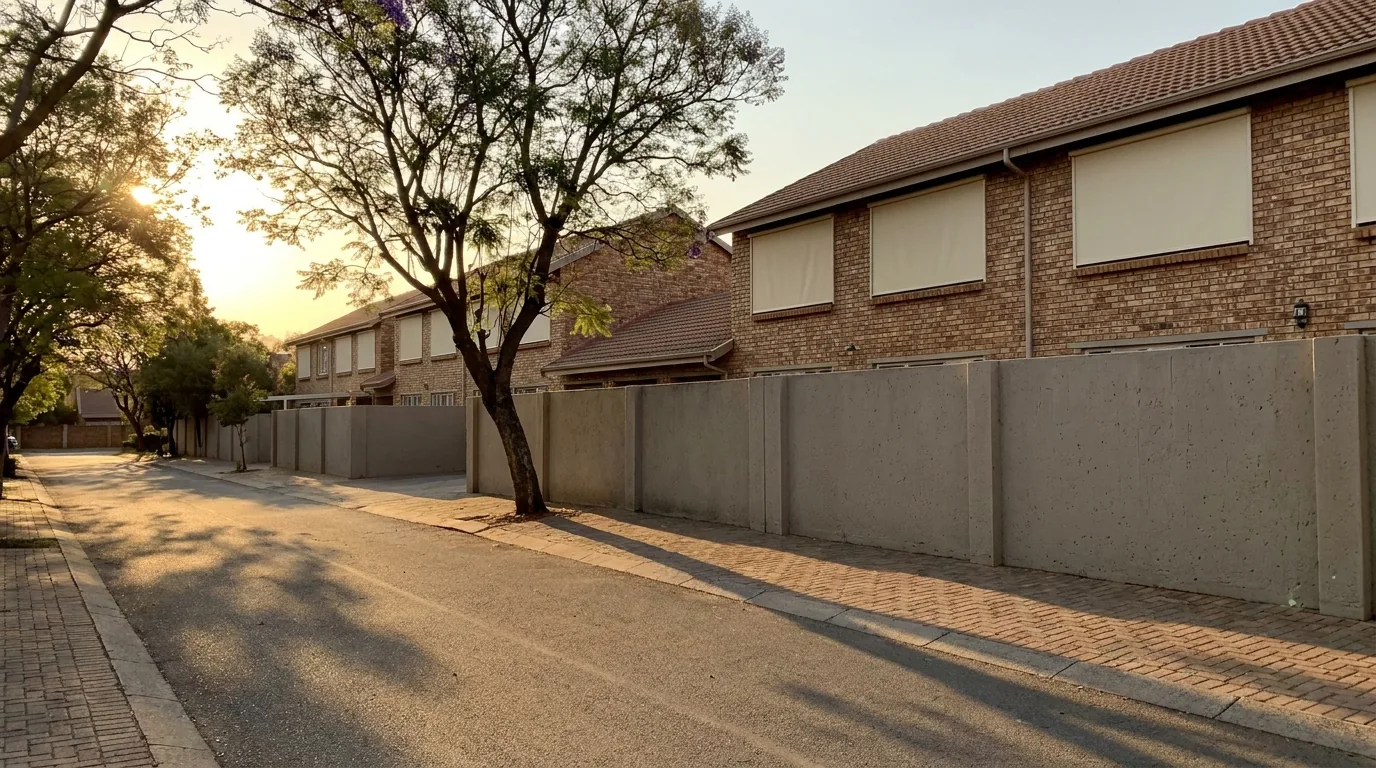
Rivonia proper is small — under a square kilometre — and splits almost down the middle: roughly 280 freehold homes against roughly 270 sectional-title townhouses and apartments.2 That split decides more about your blinds than any swatch will.
Freehold here is old smallholding stock: subdivided farm plots, deep verandahs, thatch, no two windows the same.2 Sectional title is the opposite — one drawing, the same window repeating through the complex, and what shows from the street not entirely your decision.
It is written for both, and it is what our consultant works from walking a unit: which way the glass faces, what the sun does to it in January and in June, and what we would fit. Rivonia sits at 26°3′S, between the Braamfontein Spruit and the Sandspruit, a shade over 1,750 m above sea level.1, 5 Everything below follows from those three numbers.
02 — The light here
A sun that moves fifty degrees a year.
Rivonia lies just south of the Tropic of Capricorn, which is why a window that behaves impeccably in June can be unliveable in January.
At midday on about 21 December the sun stands roughly 87 degrees above Rivonia — within three degrees of straight overhead. At the June solstice it sits at roughly 40 degrees.3 Both come from the same arithmetic: 90° minus the gap between our latitude and the sun's declination, which swings between +23.4° and −23.4°.4
The translation: in summer your north face is shaded by its own eave; in winter that same face lets low sun several metres into the room — free heating in July, and what southern-hemisphere passive design aims for.11 North glass is rarely the problem here. West glass is.
And west is a moving target. The sun sets in the south-west in December and the north-west in June.3 Run the sunset-azimuth arithmetic for our latitude and those points sit about 26° either side of due west — a fifty-degree swing. So the west bedroom is never hit twice from the same place — which is why a fixed pergola or a single tree so seldom solves one, and why something retractable usually does.
1,753 m above sea level. UV rises roughly 10% per 1,000 m of altitude.5, 6 Outdoor fabric is a different specification here, not a different colour.
713 mm of rain, almost all October to March. Nearly the whole year's weather arrives in one season, mostly as afternoon thunderstorms.5
The Highveld is South Africa's hail belt, and hail peaks October to December.7, 8
Storms peak in the afternoon — the same hours an awning is out.9
Winter nights near zero, light frost on open ground.10 Glass loses heat all night. That is the cellular-blind argument, below.
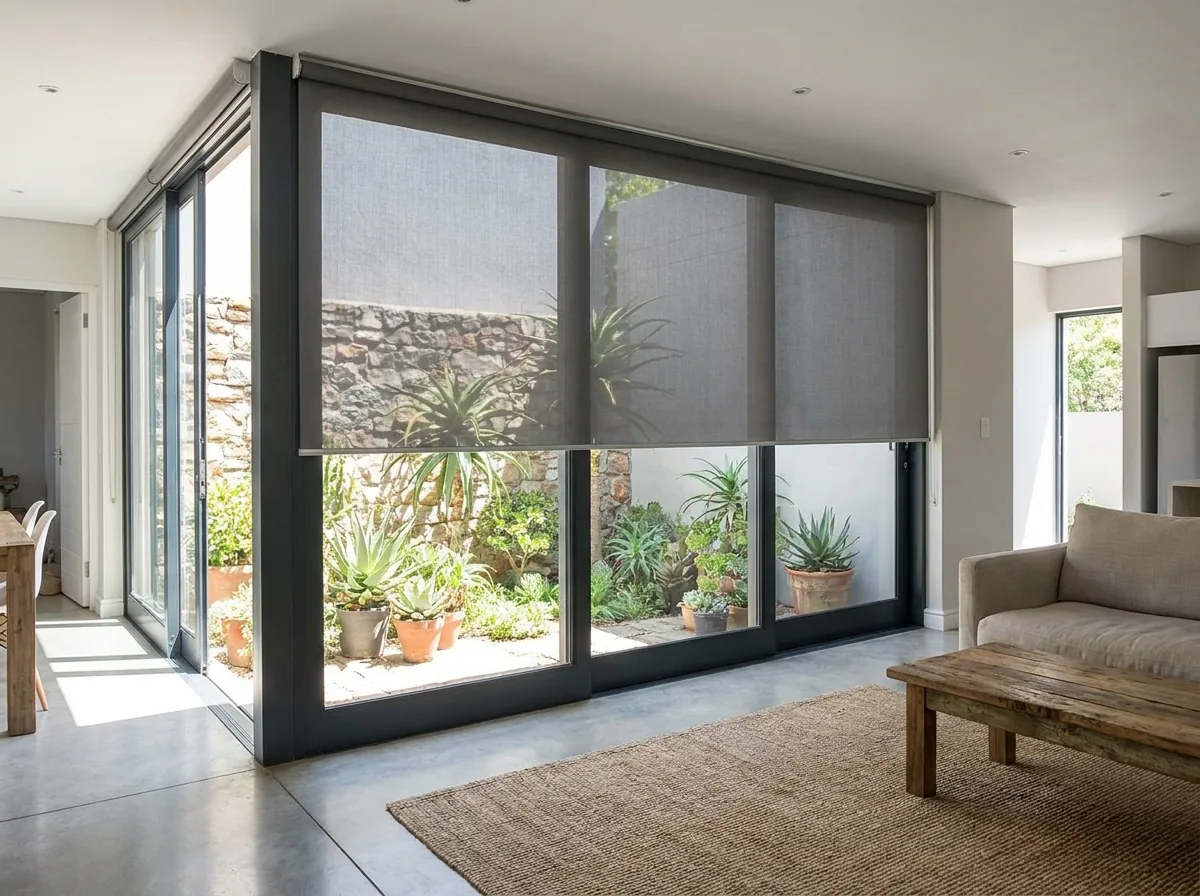
Sunscreen, not blockout, on a living-room slider. Fine open-weave mesh takes the sting out of the glare and keeps the courtyard in view. Close the same opening with blockout fabric and you have swapped a bright room for a dark one at three in the afternoon.
03 — Elevation by elevation
Four faces, four different arguments.
Walk outside and note which way each room's glass points. Everything else hangs off that one observation — it is the first thing our consultant writes down.
N
North
The good elevation in both seasons — if you leave it adjustable.
Summer sun passes almost overhead and a normal eave does most of the work; winter sun comes in low and warms the room, which you want. The problem is glare and fade, not heat.
What we fit: something you modulate — sunscreen rollers or aluminium venetians. Blockout here closes off your one free source of winter heat.
E
East
A short, sharp problem that lasts about two hours.
Early sun arrives almost horizontally and reaches deep into the room: waking with it in December, or an hour of kitchen glare. Then it is gone all day.
What we fit: blockout rollers in east bedrooms — two hours is still a problem at half past five. Elsewhere, day/night blinds kill the glare band without darkening the room.
W
West
The elevation this suburb actually phones us about.
From about three o'clock the sun is low, strong and pointed straight at the glass until it sets, and an eave barely touches sun at that angle. Rivonia's cluster stock puts a lot of bedrooms on this face with nothing in front of them — no verandah, no tree, often a boundary wall radiating heat back.
What we fit: the one face where indoor fabric fights a battle already lost at the glass. Details in the next section.
S
South
No direct sun to speak of — and the coldest room in the house.
South glass sees very little direct sun all year: nothing fades, nothing overheats. It loses heat instead, every night of a Highveld winter — which is why the south bedroom is the one nobody wants in July.
What we fit: insulate rather than shade — cellular blinds trap still air against the pane. If a close neighbour is the issue, venetians you tilt beat a fabric you must fully close.
The Rivonia advantage
In a complex, you only solve each window once.
A townhouse is built from a drawing, so the same opening appears again and again. Decide what belongs on the west bedroom and you have decided it for every west bedroom in the unit — often your neighbour's too, because theirs is the same drawing.
So we measure a whole unit in one visit and quote it as a schedule rather than eleven separate jobs.
Decided once. Fitted as a set.
Want this marked up for your house?
We’ll note your own rooms against it and email it back.
Tell us which rooms are the problem and we will send this guide back with your own openings written into it. No visit is booked and nobody phones you.
04 — What we would fit, and why
Every recommendation has a catch. Here they are.
Add anything that sounds like your house as you read — it carries into the ballpark tool and the measure form below, so you never type it twice.
Blockout roller blinds
West & east bedrooms
Why this, not a day/night blind. One flat sheet of opaque fabric on a tube gives a bedroom the binary result it wants, in a clean line repeated across four identical windows. A day/night blind has a lovely halfway setting but never goes fully dark.
The honest catch: on a west window it stops light, not heat — the pane still warms and radiates into the room behind the fabric. If the complaint is temperature rather than glare, read the roller shutter entry first.
Sunscreen roller blinds
North & west living rooms, sliders
Why this, not blockout. The same roller in an open-weave mesh: it cuts glare and a useful share of solar heat while you keep the courtyard in view, which is normally why the room has that much glass. Blockout fixes glare by removing the daylight and the view, so most people leave it up instead.
The honest catch: no night privacy at all — after dark with the lights on, a weave you see out of is a weave others see in through. On a street-facing lounge, use a day/night blind.
Day/night blinds
Street-facing lounges, east rooms
Why this, not two blinds. Alternating sheer and solid bands on one roller: align them for privacy, offset them for filtered light, from one headbox — tidy where the street elevation should read as one decision. A sheer plus a separate blockout is better optically, but it is two blinds, two brackets and twice the depth in the reveal.
The honest catch: a more complex mechanism than a plain roller, and it never reaches full darkness. Not the blind for a nursery.
Aluminium venetian blinds
Kitchens, bathrooms, north rooms, close neighbours
Why this, not a roller. Tilting slats steer light instead of only stopping it: cut the sightline from a townhouse two metres away while keeping the room bright. A roller is up or down, with no setting that gives privacy and still lights the counter.
The honest catch: slats collect dust, and cleaning them is a real task on a wide window. Timber venetians look warmer in a lounge but should stay out of a bathroom — steam and timber slats are a slow-motion argument.
Cellular / honeycomb blinds
South rooms, cold bedrooms
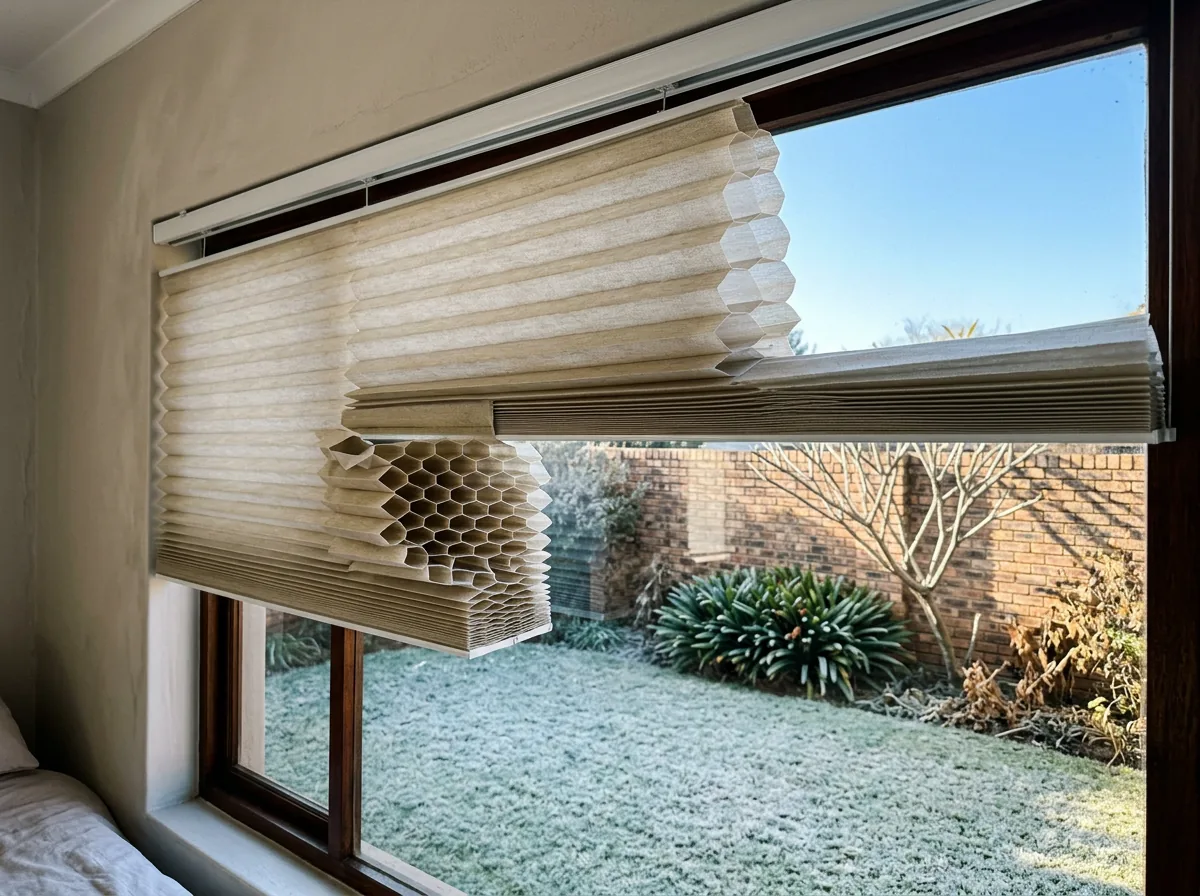
Why this, not heavier fabric. The pleats fold into hexagonal cells holding still air against the glass. Where the problem is heat leaving on a near-zero night rather than sun arriving,10 that trapped air does what no single layer can — a heavy blockout only feels insulating.
The honest catch: more than a plain roller for the same opening, and on a west window it is the wrong tool — insulation bought to solve a glare problem.
Roller shutters
The west room that genuinely bakes
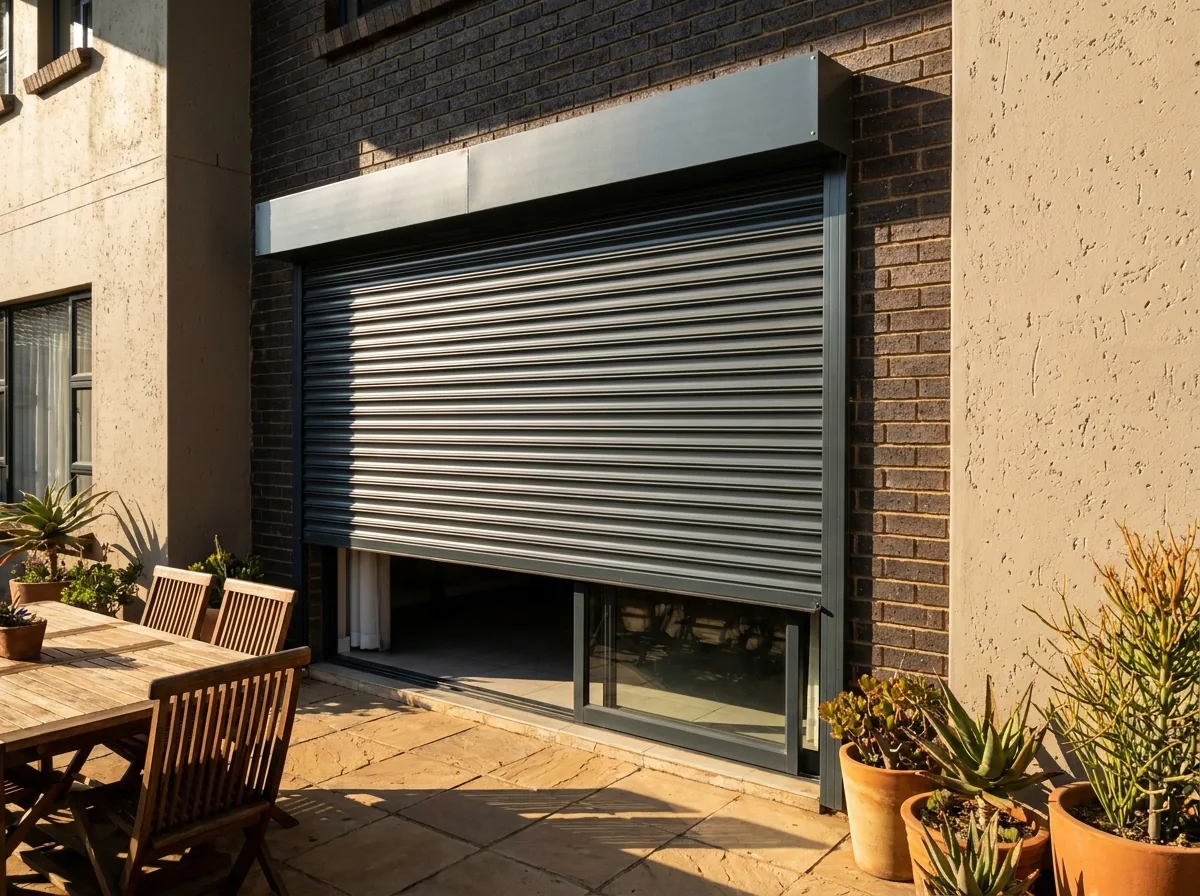
Why this, not an indoor blockout. Rigid aluminium slats rolling down on the outside of the glass, from a headbox above the opening. It is the physics answer to a west elevation: stop the sun before it reaches the pane and the room stays cooler, because an interior blind that has absorbed the heat radiates it back all evening.
The honest catch: a bigger job and a bigger number; it changes the outside of the building, which in a scheme means the trustees, in writing.12 These are shading shutters, not security-rated shutters — a different product, quoted on request.
Zip screens & folding-arm awnings
Stoeps and patios on the west side
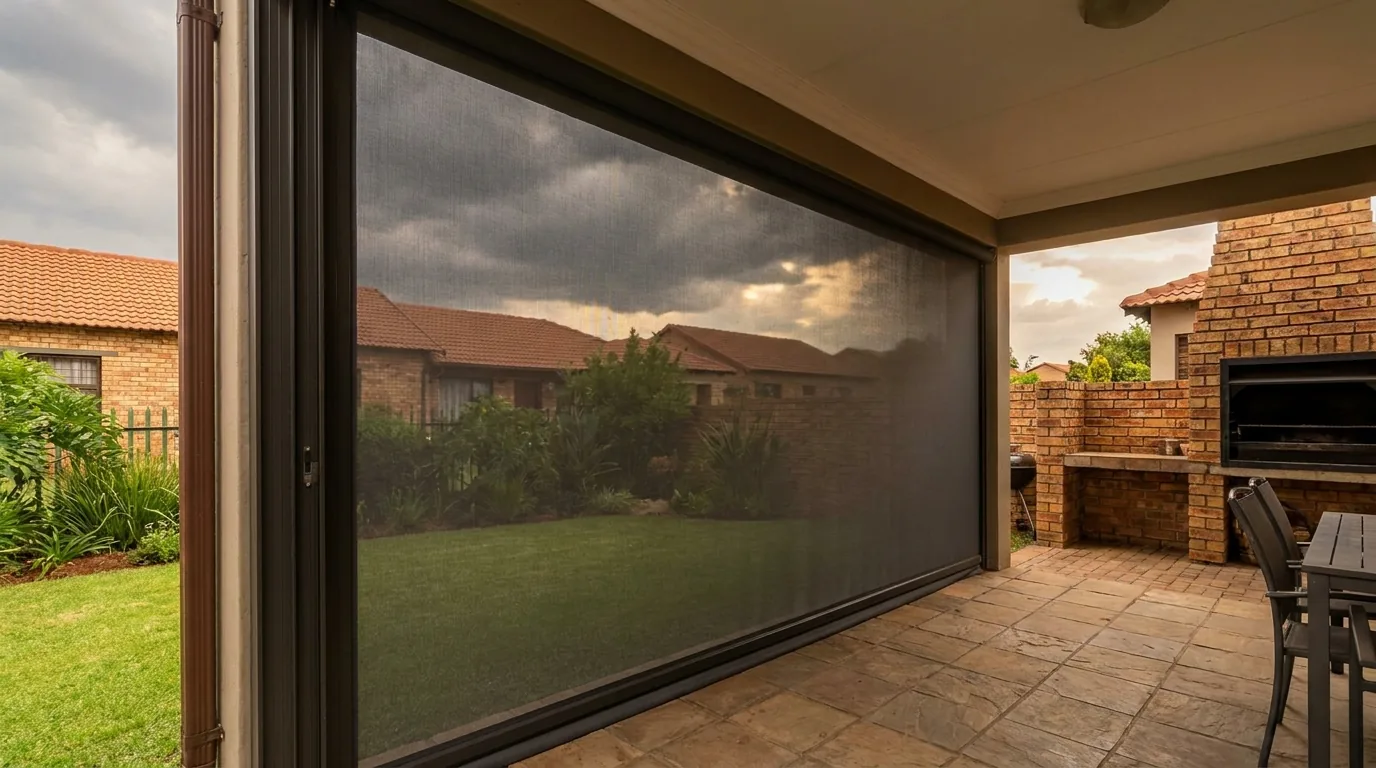
A screen, or a canopy? A zip screen is outdoor mesh held at both edges in side channels so it cannot lift or flap — it kills low western sun across an open side. An awning is a canopy on folding arms, out for the December afternoons and folded away in June so the low northern sun still reaches the doors, which a fixed roof cannot do.
The honest catch: the weather. Storms peak in the afternoon,9 hail runs October to December,7, 8 and an extended awning in a hailstorm is a repair bill — on an exposed patio we would specify a wind sensor rather than trust anyone to remember. Side channels also need something structurally sound to land on, and both are external changes, so scheme consent applies.12
Motorisation
High stairwells, very wide blinds, west rooms, children's rooms
Why this, not a chain. Its best use here is unglamorous: a timer dropping the west blinds at three o'clock while the house is empty, so the room never heats up at all. It is also the only genuinely cord-free option for a child's room.
The honest catch: more per window, and power has to reach the headbox — a wall-chase decision rather than a blind decision. Many existing blinds can be motorised without replacing them, which is often the cheaper honest answer.
Outside the glass, on the west. Rigid aluminium slats rolling down from a headbox on the outside face. Shading shutters, not security-rated shutters — and in a scheme, an external change that needs the trustees in writing.The south bedroom in July. Hexagonal cells hold still air against the pane. Nothing about this window is a sun problem — it is a heat-loss problem, and it wants a different product.
05 — Schemes, trustees and thatch
What the rules actually say.
With roughly half of Rivonia in sectional title,2 this decides whether the best answer for your west room is available to you at all.
A scheme's default rules are the Prescribed Conduct Rules made under the Sectional Titles Schemes Management Act. Rule 5(1) says an owner may not, without the trustees' written consent, change the external appearance of their section or its exclusive-use area, unless the change is minor and does not detract from the appearance of the section or the common property. Rule 5(2) extends that to what is visible from another section, the common property or outside the scheme.12
In plain terms: anything mounted outside the glass needs the trustees in writing. Anything inside usually does not, though the backing colour facing the street is very often specified, because that is what the scheme sees.
Your scheme may also have registered rules that differ from the prescribed set, so the only reliable source is your own scheme's — bring them to the measure and we quote to them rather than guess. Trustees say yes far more readily to a written specification with a drawing and a colour than to a verbal description.
On the freehold side, Rivonia's older stock includes thatched houses.2 Deep eaves already do a lot of shading work, so there we specify less, not more.
A reasonable order of operations. Read your scheme's rules. Note which openings face west. Decide inside-the-glass or outside-the-glass for those. Only then talk fabric — it is the last decision, not the first.
Five o'clock, late November. The screen is doing two jobs at once — the low western sun off the paving, and the wall of weather arriving behind it. Side channels are what stop it flapping; whether your patio has something solid to fix them to is a site question.
06 — The limits of a guide
Five things this page cannot tell you.
Everything above is true of Rivonia generally. These five are true only of your house.
The reveal depth, to the millimetre. Whether a blind fits inside the opening or has to sit outside it changes the product, the light leak down the sides and the look from the street. Aluminium frames in newer cluster stock are often shallower than they look.
What is actually behind the plaster. A lintel, dry-wall, a steel frame and a plastered concrete surround all take a fixing differently — and an external product on a west wall carries far more load than an indoor blind.
Your real wind exposure. A patio tucked into an L of the building and one facing open lawn towards the spruit are different specifications for the same awning. We found no wind measurements for these streets — it is judged on your paving, looking at what is upwind.
Whether your room sits in a cold pocket. Cold air drains downhill at night into low ground it cannot escape, where minima run several degrees below the surrounding land.13 Rivonia lies between two spruits,1 so stands sit at different levels — and it decides whether a south bedroom wants cellular or a plain roller.
The power route, and what your scheme has already approved. Motorising is a cable decision as much as a blind decision. Trustees have often approved a colour or profile for someone else already, which turns your consent letter into a formality.
07 — Two ways forward
Book the free expert measure.
A consultant comes with samples, measures every opening properly, answers the five questions above and leaves you a written quote itemised per window. It costs nothing and commits you to nothing. Would rather have a rough number first? The ballpark tool sits inside the form — same enquiry, no obligation either way.
Free in-home measure with fabric and slat samples
Written quote, itemised per window, no obligation
We quote to your scheme’s rules if you bring them
Still deciding? Say so on the form and we will leave you be
Five to six measures a week is what one consultant covers properly across this area — the real constraint on the diary, and there is no countdown running anywhere on this page.
Anything you added while reading is already ticked on the form.
Book your free expert measure
We answer enquiries seven days a week.
Working out
Sources
Every geography, climate and legal claim above traces to one of these. Where we have reasoned from them rather than quoted them — the sunset angles, for instance — the text says so.
Solar declination cycling between +23.45° and −23.45°, the basis of the noon-altitude arithmetic used above. sciencedirect.com — solar altitude
Johannesburg’s altitude of 1,753 m, its Köppen Cwb climate, 713 mm of annual rainfall and the October–March thunderstorm season. en.wikipedia.org/wiki/Johannesburg
Prescribed Conduct Rule 5 under the Sectional Titles Schemes Management Act: no change to the external appearance of a section without the trustees’ written consent unless it is minor, and the same control over items visible from outside. Paddocks — actions trustees can approve · rule text: Annexure 2, Prescribed Conduct Rules (PDF)
What we could not verify, and therefore have not claimed: any hail or wind figure specific to Rivonia’s streets, whether any particular stand sits in a cold pocket, and the rules of any individual scheme. Those are read on site, or read off your own scheme’s registered rules.